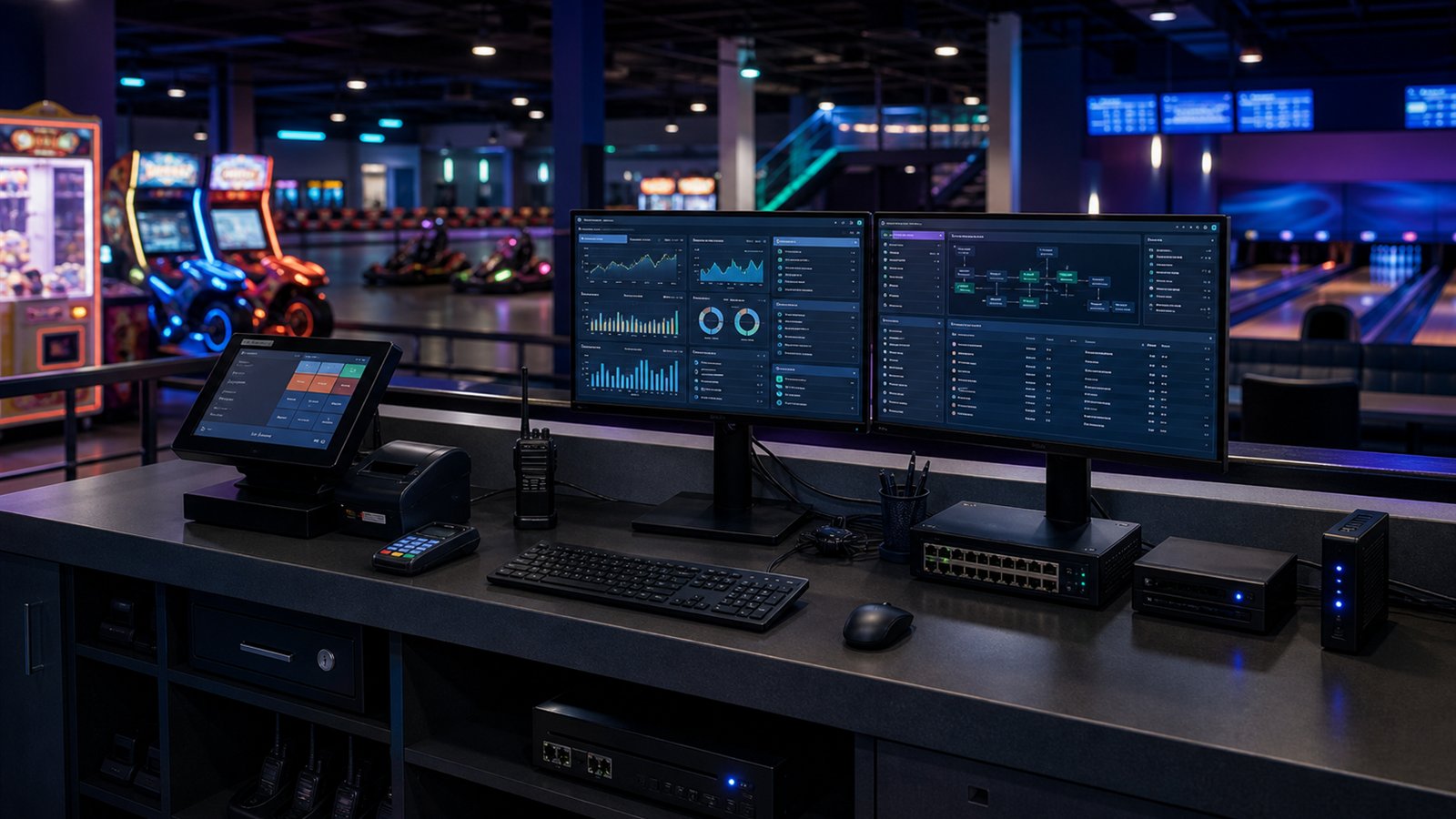
Entertainment Venues

IT support for entertainment venues where multiple vendor systems share one infrastructure.

Family entertainment centres run arcade card systems, go-kart timing, bowling scoring, laser tag, POS, and guest WiFi from different vendors on the same network. When nobody owns the shared infrastructure layer, conflicts between those systems become a recurring problem.

  • Intercard, Embed, and arcade card system support
  • Apex Timing go-kart and race management systems
  • Brunswick bowling, scoring, and lane management
  • Delta Strike laser tag and attraction control
  • Touch Bistro POS and food service infrastructure
  • Venue-wide network segmentation and WiFi coordination

Multiple attraction vendors, one shared infrastructure, and nobody responsible for how it all fits together.

A typical family entertainment centre runs half a dozen vendor platforms at the same time. The arcade card vendor supports their system. The go-kart timing vendor supports theirs. The POS vendor handles food service. The bowling scoring vendor handles lanes. Each of those vendors knows their own platform, but none of them owns the shared infrastructure underneath.

When a POS vendor's WiFi configuration interferes with the arcade card system, or guest WiFi saturates the same channels the attraction platforms depend on, nobody coordinates the resolution because nobody is responsible for the whole environment. That gap is the problem Treo fills: single-point infrastructure ownership across the vendor landscape so the systems can coexist reliably.

What usually creates the friction

The trigger is rarely one system failing. It is what happens when multiple vendor systems share infrastructure nobody is managing.

  • A POS vendor's WiFi setup conflicts with the arcade card system's network requirements
  • Each attraction vendor supports their own platform but nobody owns the shared infrastructure
  • Guest WiFi, payment processing, and attraction systems compete on the same network
  • Peak-hours network congestion degrades attraction performance or payment processing

What Treo handles in entertainment venue environments

The scope depends on the venue, but this is the practical work that keeps vendor systems running and the shared infrastructure underneath them stable.

Arcade card systems and game management

Cashless card platforms are central to how guests interact with arcade attractions. Treo supports both Intercard and Embed card systems, along with the game controller connectivity, prize management infrastructure, and network requirements that keep them operating reliably across the venue floor.

  • Intercard and Embed cashless card system support
  • Game controller connectivity and configuration
  • Prize management and redemption infrastructure
  • Card system network requirements and troubleshooting

Go-kart timing and race management

Real-time race data, accurate lap timing, and results displays all depend on reliable infrastructure. Treo supports Apex Timing and the network, timing hardware, and display systems that keep the race management platform running cleanly during peak hours.

  • Apex Timing platform support and configuration
  • Timing infrastructure and sensor connectivity
  • Results display and leaderboard systems
  • Network requirements for real-time race data

Bowling systems and lane management

Scoring, lane control, league management, and reservation integration all need to work together without interruption. Treo supports Brunswick systems and the infrastructure that connects scoring displays, lane mechanics, and front-desk operations into a reliable workflow.

  • Brunswick scoring and lane control support
  • League management and scheduling systems
  • Reservation and booking integration
  • Scoring display and lane infrastructure

Laser tag and attraction control systems

Arena-based attractions depend on networked scoring, vest communication, display systems, and session management. Treo supports Delta Strike and similar attraction control platforms, along with the arena networking and display infrastructure they require.

  • Delta Strike and attraction control platform support
  • Arena networking and vest communication systems
  • Scoring and display infrastructure
  • Session management and guest-facing systems

POS, food service, and payment infrastructure

Food and beverage operations run on their own set of systems alongside the attractions. Treo supports Touch Bistro POS, kitchen display systems, and the payment processing infrastructure that needs to stay isolated from attraction traffic for both reliability and PCI compliance reasons.

  • Touch Bistro POS support and configuration
  • Kitchen display and order management systems
  • Payment processing isolation and reliability
  • PCI compliance considerations for venue environments

Network foundation, segmentation, and venue-wide infrastructure

This is the cross-cutting layer that every other system depends on. VLAN segmentation keeps vendor systems from interfering with each other. Guest WiFi stays isolated from operational traffic. Vendor WiFi deployments get coordinated instead of competing. Peak-hours capacity gets planned so revenue-critical systems hold up when the venue is busiest. One point of infrastructure ownership ties it all together.

  • VLAN segmentation for vendor system coexistence
  • Guest WiFi isolation and capacity management
  • Vendor WiFi coordination and channel management
  • Peak-hours capacity planning and infrastructure reliability

How entertainment venue IT support works in practice

The value is not just a list of vendor platforms. It is how the support accounts for multi-vendor coordination and the high-traffic reality of a public venue.

Survey

Understand the full vendor landscape and where the infrastructure conflicts are.

Which attraction systems, POS platforms, and guest-facing technologies share the same infrastructure? Where are the conflicts and single points of failure? The first step is a clear picture of what every vendor needs and where those needs collide.

Segment

Separate vendor systems onto properly isolated network segments.

Vendor systems, guest access, payment processing, and attraction platforms get placed onto isolated network segments so they stop interfering with each other. Segmentation is the foundation that makes multi-vendor coexistence possible without constant conflict.

Coordinate

Work across vendors to resolve infrastructure conflicts.

WiFi channel assignments, network requirements, and connectivity dependencies all need to be reconciled across vendors so each platform gets what it needs without undermining the others. This is the coordination work that no individual vendor will do on their own.

Stabilize

Establish monitoring, redundancy, and peak-hours capacity.

The infrastructure needs to hold up during high-traffic periods when revenue is highest. Monitoring catches problems before they reach guests. Redundancy protects against single points of failure. Capacity planning ensures Friday nights, weekends, and birthday party surges do not overwhelm the network.

Support

Provide ongoing support that accounts for the venue's operating reality.

Entertainment venues are busiest on evenings and weekends. Seasonal demand creates additional spikes. When a guest-facing system fails during peak hours, the impact on revenue and guest experience is immediate. Support needs to reflect that reality, not office-hours assumptions.

Common questions about entertainment venue IT support

These are the questions we hear most often from venue operators evaluating whether they need a different kind of IT support.

Do you support Intercard and Embed arcade systems?

Yes. Treo has direct experience with both Intercard and Embed cashless card platforms and the infrastructure they depend on, including game controller connectivity, prize management, and the network requirements that keep these systems running reliably across the venue floor.

Can you resolve WiFi conflicts between vendor systems?

Yes. Vendor WiFi coordination is a core part of what Treo does in entertainment environments. That means assessing competing wireless requirements, resolving channel and placement conflicts, and establishing a managed wireless environment that serves all vendors without the interference that comes from uncoordinated deployments.

What about peak hours and seasonal demand?

Support and capacity planning account for when the venue is busiest. Friday-night rushes, weekend peaks, birthday party surges, and seasonal load are all part of the operating reality. Infrastructure that holds up only during off-peak hours is not holding up at all.

How does this connect to managed IT?

Many entertainment venues also need broader IT support for office staff, Microsoft 365, security, and general infrastructure. The venue-specific work often sits alongside a managed IT relationship where Treo handles both the attraction systems and the surrounding environment.

Need clearer support for the systems running your venue?

A conversation can help clarify where vendor conflicts, network congestion, or infrastructure gaps may be creating friction, and whether Treo is the right fit for your entertainment environment.

Talk to an Expert